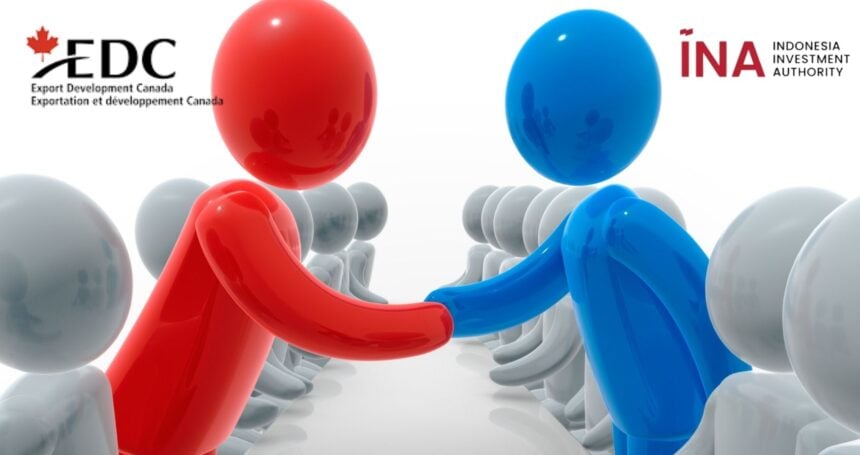
The Indonesia Investment Authority, which manages Indonesia’s sovereign wealth fund, has signed a memorandum of understanding with Export Development Canada.
This agreement sets aside up to C$825 million, or about US$600 million, to support projects that connect Canada and Indonesia.
EDC said in an official statement that the agreement was signed in Ottawa on September 25 and covers working together on infrastructure, clean technology, renewable energy, and agrifood.
The money will be available to help INA make investments that meet the partnership’s standards and are in line with the goals of both institutions.
The deal makes it easier for Canadian exporters and financiers to get into Southeast Asia’s biggest economy. It also gives INA another way to get long-term capital.

EDC is promoting the partnership as a way to combine its lending and risk skills with INA’s knowledge of the area and access to pipelines.
INA, which was set up in 2020 to encourage long-term investment in important areas, has been building co-investment platforms in healthcare, transportation, energy transition, and digital infrastructure.
Officials in Canada said that the deal was part of a larger plan to strengthen business ties with Indonesia.
More Read

In a press release, Canada’s minister of international trade said that the partnership’s goal is to help Canadian businesses get a stronger foothold in agriculture, clean technology, and infrastructure while also supporting jobs in Canada.
Todd Winterhalt, EDC’s senior vice president for international markets, said that Indonesia is a major market for Canadian exporters.
He also said that the goal of the partnership is to improve trade links in clean technologies, renewable energy, and infrastructure.
Ridha Wirakusumah, the CEO of INA, said that the goal is to direct Canadian investment into areas that are important for Indonesia’s long-term competitiveness while also creating a platform that attracts investors from around the world.
A dedicated allocation of up to C$825 million shows that the goal is to move from one-time transactions to a programmatic approach that can be used on many projects.
It also gives other export credit agencies and sovereign funds a standard to follow if they want to build thematic pipelines around energy transition and important infrastructure.

EDC-INA anchor can help bring in commercial banks and institutional investors who want to see public support early on.
The MoU doesn’t list specific assets, but the sector focus shows where deal flow is growing. Indonesia is speeding up upgrades to its grid and ports, as well as utility-scale solar and hydro projects.
It is also putting money into projects that turn waste into energy and clean water.
The agri-food angle could bring in cold chain, logistics, and processing capacity to help make food safer and more competitive for export.
Canadian companies that work in engineering, power equipment, grid software, and project services may find it easier to get the supplies they need now that the agreement is in place.
EDC’s allocation shows that they want a mix of loans and structured financing instead of just equity. This can help sponsors make the most of their capital stacks and lower the risk of having to refinance.
The timing is right because both governments are trying to make their ties stronger. Canada has named Indonesia as a key market in the Indo-Pacific, and Indonesia is looking for partners to help pay for infrastructure and clean energy as it aims for faster growth and lower emissions.
The EDC–INA agreement makes it easy for project sponsors to work with both organizations early on, which can speed up the time it takes to go from mandate to financial close.
Getting EDC financing and INA co-sponsorship may make it easier for banks to lend money, lower the cost of borrowing, and open up project guarantees that help meet lender requirements. The partnership might lead to new vendors and service providers for projects that EDC supports.
For INA and Indonesian partners, it increases the amount of competitive capital available and brings in sector knowledge that is relevant to the transition to clean energy and critical infrastructure.