
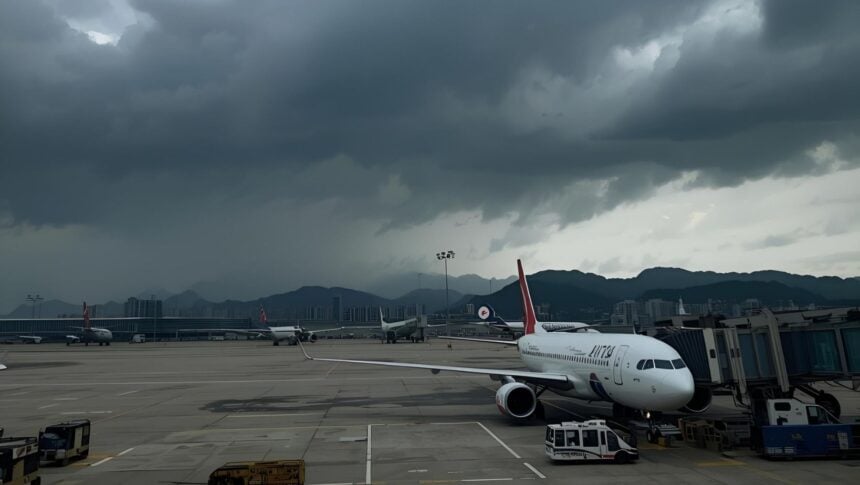
As Super Typhoon Ragasa moves across the Luzon Strait toward the Pearl River Delta, Hong Kong is getting ready to cut back on air traffic starting Tuesday night.
Airlines and local governments warned that things were getting worse very quickly. Several airlines said that passenger flights at Hong Kong International Airport would be suspended for 36 hours starting Tuesday night.
Qantas said the shutdown would start at 8 p.m. local time on September 23 and end at 8 a.m. on September 25.
The airport authority hasn’t officially closed the airport, but they are keeping a close eye on the storm.
The Hong Kong government’s steering committee on extreme weather said that the Observatory might raise Signal No. 8 between 1 p.m. and 4 p.m. on Tuesday.

Winds could be as strong as a gale or storm on Wednesday, and offshore and on high ground, there could be hurricane-force gusts.
The advisory told people and businesses to make sure their backup plans are in place before things get worse.
Cathay Pacific told customers that it expects a lot of problems and is letting people change or get their money back for tickets bought on or before September 21 for travel between September 23 and 25.

The airline has said that more than 500 flights could be cancelled if the 36 hour suspension goes ahead. It also said that arrivals and departures will stop from Tuesday evening until Thursday during the day.
Hong Kong Airlines put up a list of cancelled flights, including long haul ones, and said that some flights might not be able to check in online.
Late Monday local time, the carrier sent out its most recent update. This was while the city’s four biggest airlines were making big changes to their schedules.
Travellers were told to book their trips early and be ready for long wait times at the call centre.
Local news and business sources said that about 700 flights could be cancelled around the time the storm was at its worst. This shows how bad the disruption was at one of Asia’s busiest airports.
Even a single day of limited operations at Hong Kong can have an effect on schedules and cargo flows throughout the region. A 36 hour halt would be felt by airlines all over Asia Pacific and beyond.

Ragasa has already caused parts of the northern Philippines to close and people to leave, and it has also set off alerts in Taiwan and southeastern China.
Meteorologists said on Monday that the cyclone was one of the strongest of the year, with winds that stayed above the level for a Category 4 hurricane on the Saffir-Simpson scale.
The Hong Kong Observatory said that things would get worse quickly starting on Tuesday, with thunderstorms and squalls likely to happen often.
If you are flying to or from Hong Kong or a nearby airport this week, the first thing you should do is check your airline’s travel advisories and keep an eye on your email or app notifications.
Most airlines are waiving change fees and letting people book new flights for later dates, but there may not be many available seats until things go back to normal.
If you have to go through the area, give yourself some extra time and have a backup plan through other hubs.
The storm also has effects on investors and people who plan logistics. Hong Kong is an important hub for high-value belly-hold cargo going between mainland China and markets around the world.
Long-term disruptions can slow down shipments of electronics, pharmaceuticals, and e-commerce that are worth a lot of money. They can also make it harder to find space for airfreight on routes to Southeast Asia in the near future.
If the airport’s infrastructure or ground systems were seriously damaged, it would take longer to recover. However, officials stressed that backup staff and equipment have been put in place before the storm hits.